Thinking aboutA Trace in the Sand

by Ruth Malan


Architects Architecting Architecture  

May 2012

  05/01/12

by Sara B.What's a Trace?

This Trace is just where I jot notes as I explore in and around the territories I associate with architects architecting architecture. Since I work with architects across the spectrum from applications to enterprises, the scope of my exploration flexes accordingly. For a playful orientation to this Trace, you can read the characterization I assembled here, or selection of posts I assembled here, or visit my in-progress Journal Map.

May you be this happy!


Enterprise Architecture as Strategic Advantage

Given that the contribution and relevance, even the very future, of EA is oft called into question (the latest prompt being here), you may be interested in bringing some exposure to EA as a source of strategic advantage:

One of our clients has won the Enterprise Architecture Award, and architects from at least one of the other winners have taken our EA workshop. Naturally, while we can't claim any credit as they did it all themselves, I do think it is a marked demonstration of excellence to choose to work with us. ;-) As you know from our papers, our orientation to architecture is very much about enabling strategy.

With ever increasing complexity and wave after wave of change, I believe the question is not whether EA will continue to be relevant and essential, but whether we can get a strong enough handle on it ourselves, otherwise it might have to make its contribution under another name because we flub this one/cause it to develop #fail antibodies! Truly, I am not in the least bit worried about the need for all manner of systems design expertise. We -- we digital/compute/technology types -- are reshaping the landscape of business. And design is riding an awareness wave right into the executive suite. So, surf that wave with what Jeanne Ross has to say about EA in Busting CIO Myths (April 29, 2012), and follow it up smartly with Fractal and Emergent. :-)

Wave after wave of change? Here's a sampling of what we're doing:

  • manufacturing jobs go to silicon and steel: A third industrial revolution: As manufacturing goes digital, it will change out of all recognition says Paul Markillie, Apr 21st 2012 [3D printing implications for small batch sizes since don't have high cost of set-up (molds, etc.); product family on single production line through parameterized components; automation and robots; carbon fiber composities]
  • sales goes to digital+social: Death of the Salesmen: The Geeks Did It, Michael Vizard, April 24, 2012
  • Introducing Fit for Purpose Architectures, Tom Deutsch, April 30, 2012

We're changing the world, weaving digital ever deeper into our organization's capabilities and that weaving, if we're to achieve more the outcomes we want, needs to be designed*. And because it's complex and we're not all-knowing let alone prescient, it behooves us to consider the feedback on experimental design nudges and adaptations and further adapt and learn. All the matter of enterprise architecture as an adaptive, evolutionary, part-intentional part-emergent process that partners closely with strategy. Which is to say, a key part of what we do is design feedback loops into strategy, and those too need to evolve!

And because we're the stewards of such massive reconfiguring of society, we need also to be careful to take into account sustainability in all its forms, including environmental, social and economic. Reading in the ecosystem thread on my ongoing investigations, I thought this was interesting:

We're going to make interventions into the webs of life on this planet. We just are. Too many people, each of us aspiring. So, we need to get smarter not just about our cities but our organizations, our farms, everything. Enterprise architecture is about attending -- studying, designing and adapting, reconsidering, adjusting, aligning, evolving -- interwoven, interacting, enterprise socio-technical systems that extend within and without the organization. Big stuff. Strategically critical but by no means universally understood to be, and hence a great source of strategic advantage to those who get it..

5/2/12: Well, it's ugly when someone -- especially a "lady" -- says "I told you so" but really... this is so "like we've been saying":

Except that we've also been showing how to do that for a decade! Of course, you can take this as a challenge to go back to our What it Takes to be Great and EA as Strategic Differentiator papers to verify that my claim is accurate. ;-)

Oh, I well know that others, including Tom Graves, have been doing likewise. Goodness, what is low hanging fruit for if not to pick? Now, as low hanging fruit goes, Gartner hung out some really juicy ones with that article! To be effective, we have to change our focus from deliverables to outcomes. Sure, sure, there'll be dashboards and even blueprints, etc., where needed. But if we don't focus on outcomes, we're not asking ourselves that crucial "what is the most important..."

Oh my, this is indeed not the most important thing for me to be doing at this extraordinary moment! I have a deliverable to turn in! Ta ta! ;-)

* At different (fractal) strategy and design scopes, and sometimes with more intentionality, and at others allowing emergence to reveal patterns and yield outcomes we learn from before adapting intentions and designs.

Radical!

You doubtless (grin*) remember I pointed out cool stuff on mirror neurons and your brain on metaphors. Now you can add this to your set of downright exciting breaking news in brain understanding:

Architecturally significant? Well, goodness me, you view yourself as a leader, don't you? You want to achieve system integrity that is as if of one mind, right? Well? Guess what's coming -- you'll learn the lesson all the more thoroughly!

And you wondered why I ask so many questions about what I am about to say next? Ha! But ooh, now I know how to position my habit of not finishing sentences. ;-) Ah yes. I wonder what rhetorical fallacies I've leveraged here?

Wink.

* Hey, the advantage of Tracing is memory enhancement -- I just have to remember what I noted, not where I did so because googling my site gets me to where (try "metaphor brain site:ruthmalan.com" and see the first result). More seriously, Tracing is a process of reflecting:

"Reflection is turning a topic over in various aspects and in various lights so that nothing significant about it shall be overlooked—almost as one might turn a stone over to see what its hidden side is like or what is covered by it." -- John Dewey, How We Think

though I like how Daniel Stroe put it:

"...the human capacity to adapt which consists in mind’s ability to simulate realities, to dream. This synthetic ability has to be guided, and there is a medicine against the illusions, it requires a constant mind repositioning to shade new angles and perspectives to the issues. Find a spin and it will feed a fresh light for a while (there are infinite things to know and there is limited life to learn)." -- Daniel Stroe, Don't believe the obvious!, 8/23/09

Here's an example of considering something from an interesting angle:

Keiretsu and ecosystem weaving. Still no interest in what I'm up to? Look, tell you what. We won't fire me. We'll fire you. Oh, ok, we won't do that, but, goodness, you could be a little encouraging now and then! It gets lonely out here on the ecosystem branch with only faint indirect voices to be heard over in Cannes and other places. ;-)

5/3/12: See also: The Storytelling Animal: The Science of How We Came to Live and Breathe Stories, Maria Popova, 5/3/12


Connected

Alright, just so you can feel fully connected and suitably concerned, this is our world tonight:

tornado watch

Ah, yes, connected:

Ecosystems and Relationship Platforms

Those are useful posts, though I was struck by "People talk about different platform strategies, using terms like "open" and "closed", but these terms seem to have worryingly unstable meanings." Well, while we IT folk tend to think we need to nail down definitions and standards (and we do, when it comes to interoperability, but much more arguable when it comes to process), the strategy folk aren't nearly so concerned to all speak from the same playbook. They each write their own. And its a good thing Apple didn't listen to Clayton Christensen's version... Which is not to say Christensen isn't right when he's right*, just that the name of the game in differentiation is creating differences that make a difference. That said, it seems to me that a "walled garden" lies between open and closed, and that part of the "instability" has to do with there being a spectrum (perhaps even a multidimensional space) of platform strategies. The insight to tease out of Richard's unease probably has to do with getting more of a handle on what that spectrum or space is, and I think that would be useful!

Anyway, I've been using the term relationship platform because, well, it's an architecture thing -- it's about enabling relationships (value flows, information flows, interactions and engagement, etc.). But that's just me running up my strategic flag, marking it architecture territory. ;-)

* Huh? Oh, that's just my coy way of giving Christensen no more than his due. ;-)

5/8/12: See also:

5/10/12: Richard Veryard has collected together a very useful set of pointers to platform strategy articles.

  05/02/12

Shaping Fashion

"When the Roomba robot vacuum was introduced in 2002, all the engineers I know were very excited, and I don’t recall them owning vacuums. I said, this is damn strange. This is not about cleaning floors, this is about scratching some kind of itch. It’s about something happening with robots." -- Paul Saffo, quoted in 8 Visionaries on How They Spot the Future, Joanna Pearlstein, April 24, 2012

Daniel Stroe asked me about the role of fashion in tech and I could see a blog post percolating there. Well, I'm waiting Daniel! :-) In the meantime, I think he is definitely onto something worth exploring. Does the itch instigate fashion or fashion create the itch? Whatever. Robots (and other forms of AI... not all have appendages, etc.) are emerging throughout the realms of our experience from the phone we carry to our homes and workplaces ... and space station. And we're intrigued and drawn to what they enable, for in important ways they extend and enhance us, improve many aspects of our experience.

They march into our lives with a shadow side. There's no going back. But we simply have to be more attendant to our civic and corporate responsibility in terms of people who are being sidelined by robots.

We are tantalized by robots. The itch is our own aspiration.


Who Cares?

I know, I show up too much here as myself, and that puts people off. But I believe we need to shape a world where people care -- more, not less! If we don't, what is there? We plug our heads into our devices and simply make informational connections to others, with no caring? That is a route to dystopia. We need to shape a world we want to live in! (Apologies about the language but this is just perfect for this moment we're at, isn't it)

the meaning of modern life?

So, sure, I challenge the notion that our online presence should be sterile and flat, emotionless and business-mechanical. Do we want to rouse humanity out of the industrial-machine era? Doesn't that mean investing in building stronger community bonds that move caring not just information around?

we're schooled into drones, while we school drones to think!

The way we're going, teaching robots to detect emotions and appear to respond appropriately (even with humor) while we wash so much of humanity into conformity and dullness, we'll get to the point where that becomes "The real problem is not whether machines care but whether men do."

We do need to be concerned about our social schisms. Including the exclusivity of software... and the dearth of women in our field.

5/4/12: My son's documentary, We Know, We Care, is done! He's hoping it will be shown on the community access TV station he's been doing volunteer work at this past schoolyear. Kids are so amazing! Like this: Tavi Gevinson: A teen just trying to figure it out. Showing us how to illustrate with flair, no artificial societally-imposed inhibitions restricting communication effectiveness.

I told ze boy about John's tweet. He was taken aback by the language (moi? Is he the only person in the world who avoids such language? I once explained that I prefer to avoid the f-word because it has roots in sexual aggression, and until we're done with sex being used to dominate and aggress, my small protest is to hold my own inner boycott of said explicatives. Eh. That's just a rationalization. Really I'm just a prude. Ha. Gottcha.)

5/8/12: Seth Godin's post on Caring got a fair amount of Twit-play the other day: A simple antidote to a corporatized, unfeeling, profit-maximizing world Care. I really liked the phrase "Caring gives you a compass". Anyway, I thought this was interesting:

"If a social creature did not disclose information, then other creatures might stop interacting with it," he said. "Animals do this with smells and movements, and humans do this with language. This study reveals how our brain evolved to motivate sociality, which is pretty cool." -- Randy Dotinga, People love talking about themselves, brain scans show May 7, 2012

Introverts are social creatures too. Who knew? ;-) But more:

"And today’s business empires, or autocratic states, are only temporary structures, destined to be undermined by the fundamental human desire to open up, to connect, to inspire, and to collaborate with one another." -- Irving Wladaws, Why People Are Gaining Power Over Organizations in the Age of IT, April 23, 2012


Wrong Problem

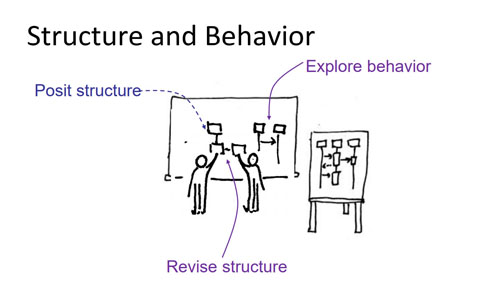
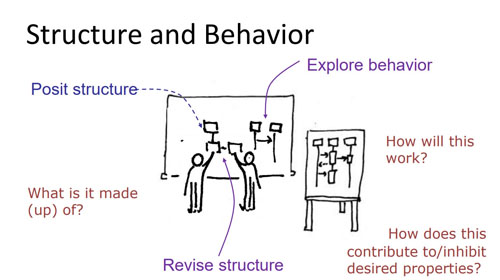
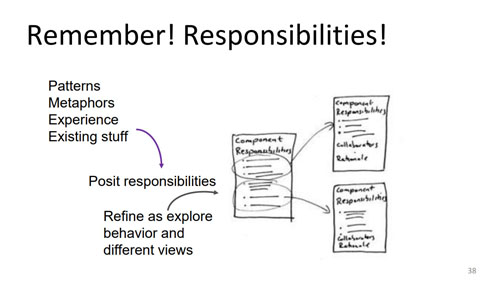
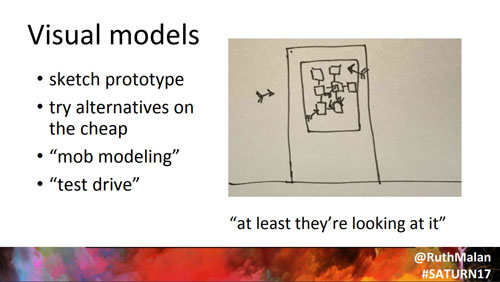
visual architecting, anyone?

And that, folks, is why Visual Architecting is the way it is. You should get some, really! And you can -- next open enrollment Software Architecture Workshop with me (Yesss! Wahoo!) is coming up in Chicago in July. Tell someone. Come yourself. It's really good like. (Don't worry, if you're an enterprise architect you can come too, we'll still be nice to you. ;-) I know a lot of software architects who wish their managers and their enterprise architects would come to our Software Architecture Workshops so there you have it.)

For those who haven't been reading along here for the past several years, and on the assumption that you have some interest in the perspective we share, what follows is a sampling of our approach to being agile in system concept exploration and development:

In other engineering fields, and in building architecture, informal sketches, rough or crudely worked, are treated as "experiments"--paper prototypes to illustrate and expose ideas to reaction and co-creation. Yes, we do this in software too--well, some of us; sometimes. -- Sketches!, 4/3/10

That is, we make these decisions tentatively, deliberately setting out to learn more -- as cheaply and quickly as possible, with pretendotypes or sketch mockups and models and code prototypes and whatever fits the magnitude and degree and consequence of the decision risk. -- Make Decisions (Stick), 2/14/11

When I first read "most cases of failure... have been in two categories: imagination and process" (Grady Booch) what I thought most about was failures in direction--doing the wrong thing because we simply didn't project ourselves in various ways--into the future when the system is in place, but other trends and forces have played out too; into use contexts, to empathetically grok what users care most about, or to assess *ilities, etc., etc. I'm not saying all of this should be done in our imagination--but if the system doesn't exist, it has to be imagined! So we imagine, and prototype, and build out iteratively, to get a more and more clear sense of where value and "delight" lie. -- Failures of Imagination, or just Optimism, 7/3/10

We truly, as a field, need to accept that our systems evolve, which means our designs evolve. But our systems evolve both because the context and need evolves and because we don't have perfect, full knowledge at any point, and certainly not a priori! This only means that sketches, paper prototypes and experimental designs, etc., are more important, not less, for they allow us to adopt a fail fast and cheap mindset to flush out good bets in terms of system use models and user experience design and design of the structures and mechanisms that deliver those value propositions. And then we need to keep working on design! Not just catching our models and documentation up to what happened to happen in the code, but being intentional about design. Intentional about making things more the way we want them to be! Again, models matter. Models are critical thinking tools for designers! All the more so, the larger and more intractable the code base becomes, with regards to thinking systemically about cross-cutting design issues. -- More Making It Visual, 9/20/10

Yeah it's messy. The diagram and the process. Early on when we're exploring the system concept and technical approaches, we need to work sketchily, working quick and dirty, experimenting in the cheapest, fastest medium to uncover value and test out approaches to addressing challenges. That way we can try out a slate of ideas as quickly and as informally as possible, allowing for more cycling using paper models and mock-ups than some "first generation agilists" may cede is useful. This approach, whereby we learn real quick by trying things out using the cheapest medium for experiment, is truly agile. And yes, we do need to timebox this early experimentation, and we need to think in terms of chunks of experimentation in the medium of models throughout our iterative and incremental process. -- Faceted Views, 12/3/10

And a good way to do that is by building something. Building core elements of the idea to test it out. Yes, that. But not forgetting that we can start to test out a gamut of ideas simply by mocking them up with sketches or creating a pretendotype with a block of wood or a role-playing game. And as we build out the ideas -- at first sketchy and then more concretely as we zero in on value -- we are not only testing out the ideas, but by demonstrating where the compelling promise lies we draw people in. -- Distinguishing a Leader, 9/6/11

And if that has whet your appetite, you may be interested in Software [Creation and] Engineering, 10/5/11.

You might also be interested in the section on Visual Thinking and Visual Design on my Trace map (my inner critic has already told me that section needs a sub-structuring/re-ordering). There are also posts like Testing on Paper collected under Improvement and Validation. Now you might react with "that's just the message in pretendotyping" or some such, but Visual Architecting long predates but also goes deeper than pretendotyping.

5/14/12:

And Visual Architecting is about iterating on both

And Visual Architecting is about exploring the "problem" and "solution" together -- tackling the dominant uncertainties and challenges of the moment. A well understood (next generation) kind of system has different challenges than systems that are defining value in an emergent ecosystem (niche). We need to adapt and flex to the design (organizational and technical) challenges of the context and the moment.

I challenge (by Sara B.)

Perspective

learn from someone with a different perspective!

And I offer a different lens, now don't I? It is interesting how people who characterize themselves as curious may have quite settled notions about authors they'll find useful or "relevant."

But, as different lenses go, this is a nice post:

And as perceptual traps go, this is also useful:

  • The false dichotomy of false dichotomies, Scott Berkun, 9/20/2011 (if you drop the "false" most places in the post, it actually works better, for the problem is with using dichotomies when our tendency to deal in polarities is muddling our thinking-acting rather than helping it)

Image: By Sara B.


Oh, Did I Mention the Workshop?

Well, right then. I'm going to extend the early enrollment discount by two weeks so let's fill this workshop in Chicago in July! It's fun. You're fun. Let's do it!

Visual Architecting Workshop Roadmap

I prefer to be your advocate, but... a workshop is great when great people participate, so I suppose I have to swallow all my history and see if this self-promotion thing works. ;-) It's lousy when one is one's own product*, it really is! Especially if one is a Q<= in which case all kinds of social forces come into play to make that very hard to stomach!

That said, in truth, if anyone who read my Trace, or knew someone who read my Trace, came to a workshop I was leading, I'd have such bad stage fright and be so self-conscious it would be altogether terrible! One really doesn't want to actually meet the people who have read her mind -- that would be, like, embarrassing! I mean, by reading here, you have so many opportunities to think me an idiot, to disagree with me, or to... think I'm pathetic. So no, I don't want to work with you either. Well, not unless you admire what I do, and get value from it. But how unlikely that is!!!

Further, if anyone says something nice about my Trace after I've done one of my imperious "I need a pig here" things, I discount that entirely! To be taken seriously, appreciation has to be genuine and so has to be spontaneous.

* Actually, I have to confess, architects are my "product," and what I have to sell is you, with whatever you inspire and enhance in yourself given the crucible we convene and create together. Which makes it all the more of sticky business trying to "sell" what I do! ;-) Unfortunately our dominance stacked world has told all of us that you should only attend to me if I come across as an authority, meaning I "mark the territory" as mine (including "positioning" and framing," which too often amounts to deriding what others do), lay claim to fame, that sort of thing. And I come along and tell you I'm here to convene dialog and draw forth from all of our experience and the interaction of our knowledge, insights and capabilities, and provide some context awareness, conceptual models, heuristics, etc., and facilitation to outcomes, but really you have the lead role to play in what you learn and make of what we do together. So, yeah sure, I act as a coach and provide a semi-structured crucible so that the workshop has flow (in multiple senses), and there are even times when I teach, often in stories but in various forms. But really you are the principal agent of your own self, and sure, I serve to add some new blends into your cognitive and experience streams, but more importantly, I help you see what you already have to work with, and remind you that you have to do the weaving, the selecting, responding, to create the great living tapestry of your becoming. But no, I don't say that! Instead I tell people we're rafting down the Colorado and it's going to feel pretty wild at times but I've taken many groups down this stretch and while it has been different every time, we'll get through so have fun. ;-)

Daniel Stroe kindly suggested I do something like Alexander Osterwalder's Business Model Theater, since what we do is highly visual and has a small set of neat conceptual organizing frameworks. Well, of course we'd have to use Dana's cool radio-quality American male voice. My South African Q<= voice is... not very commanding. (One workshop someone flat out asked where Dana was, and that actually flipped the dynamic and several architects in the workshop became really active advocates of my style and message.)

System Thinking Favs

Tony DaSilva's "Roster of System Thinkers" post and the comment on his blog inspired a quickie list of our favs. But before I go there, you might be interested in this: Russ and Bucky.

Ok, the list -- I need to clean it up, but here's the 1 minute core dump. First, there are a good number we share on Tony's list:

And some from "avatarmysti"s list (comment on Tony's post):

  • humberto maturana
  • david bohm
  • richard feyman
  • Gregory Bateson (cybernetics)

And these:

  • C West Churchman
  • erik jantsch
  • Bucky Fuller
  • Thornstein Veblen (economics, conspicuous consumption, corporate malfeasance )
  • Fred Emery
  • Eb Rechtin (systems architecting)
  • John Nash (governing dynamics)
  • Herbert Simon
  • Jay Forrester (system dynamics)
  • bernot mandelbrot (fractal)
  • john von neumann
  • Warren McCullouch (cybernetics)
  • Chris Argyris (learning organizations, ladder of inference, double-loop learning)
  • Alfred Korzybski (linguist, general semantics; foundation for NLP)
  • Virginia Satir (family therapy, systems of interaction between family members)

I haven't mentioned the Daoists and philosophers... I'm tempted to mention Joseph Campbell (myths)... the list just gets longer! The likes of Donella Meadows, John Holland, John Seddon, John Gall and Jerry Weinberg have influenced my thinking, but so has Grady Booch and it gets harder to draw the line as we transition from "founders" and early classical works to the current set of influencers. For example, Jamshid Gharajedaghi (Ackoff's heir apparent at Interact) perhaps warrants mention.

Now I need to investigate Rudy Starkermann, John Warfield, Bill Livingston, Thornstein Veblen, Francisco Varela, Heinz von Foerster, Stuart Kauffman, Pille Bunnell, George Spencer-Brown, Louis Kaufmann, John Wheeler, Buzz Holling, and Benjamin Lee Whorf.

I guess I'm going to have to put in an order for at least another life!

Thanks Tony!

5/6/2012: Bob Marshall has also created a gallery of giants (overlaps with, but not limited to, systems thinking). Nice to see the inclusion of Tom Gilb.

  05/03/12

Some Pointers

  • Jack Martin Leith's Models, concepts and methodologies Pinterest board is shaping up to be a really useful collection!
  • Martin Howitt's Framework Addict blog is pulling together a useful high-level "hit" on a broad span of conceptual frameworks and thinking tools. His second choice was a bold move, I have to say! ;-) Martin's On being awesome post is the most awesome post (or article or chunk) I've read in a long time! Seriously. Awesome. Exquisitely respectful of a different position. But really provocative -- in the best way. The reason my spirit is so taken with the post is that it speaks so eloquently to our times -- times that can make us feel like failures if we aren't the top dog hero doing something tech-glamorous, but instead more working to change the world in quieter, unlauded yet deeply important ways. Take a bow Mr. Howitt!
  • And Martin might like to use Alex Matthews 20 Key Concepts every EA Should Know list as a "to do" list for his Framework Addict blog. ;-)
  • Peter Bakker's Inspiration Pinterest board is a wonderful set of images/words/pointers I'd never encounter were it not for Peter. Peter has put a lot of time and energy into building community in our field, responding thoughtfully in his own blog and comments on others, often with a very different view that prompted us all to see a new angle on what we were working on. He has made a huge difference to my life and thinking, and I know that his engagement has made a difference to a good many other people in this field too. Peter matters! And he does cool stuff like this: Rethinking the EA Toolset.

  05/04/12

A Shifting World

When I read Avivah Wittenberg-Cox's HBR piece, I wondered if the difference has more to do with being decades in to the big shift -- a shift in the gender distribution of the workforce coinciding also with the weaving of digital through so many (approaching all) facets of life and work. Consider digital and sex. I mean sex, not gender, and Zimbardo's point about how that is reshaping youth culture -- for boys, and for girls. So we have all kinds of identity shifts going on, and it raises questions for me. Like, is the techchismo element in our field there because it is a defense mechanism in a world that is shifting in ways that make it uncertain, so that one strategy for defining identity in an ambiguous, socially challenging and changing world is to form elite tech-tribes where camaraderie among the cohort is super-strong? And exclusive.

When I was an undergrad, CS and math were pretty evenly split between men and women, and no-one suggested women couldn't or wouldn't want to do CS. There wasn't the gap then that there is now between those who programmed in middle and high school and those who didn't. Now there's a big gap. And I fear that it is like music -- kids who began taking music at a young age don't just have years head start on kids who come to it late, but their brains are different. I think that is a research area that should be something of a priority. Regardless, we should give more kids -- boys and girls -- more exposure to developing software in non-threatening settings (I don't just mean without the chismo element but where the entry-hurdles of development environment are low and the kids can just get started doing stuff that works. There'll be endless hassle-battles with the development environment thereafter, to develop that skill. Sadly.).

Of course it's not just gender distribution that shifted from pretty even when I entered software to heavily skewed. There is a sense that social changes are afoot, riding many trends including widespread higher levels of education, more technologically-enabled connectedness that puts distributed people in touch, .... So this is interesting:

As is this:

Which I contrast with this:

There's flocking and self-organizing which calls to mind:

A changing world. And I expect we are in the throes of multiple mass social "identity crises." For example, there is the crisis of consumer confidence that has something to do with the economic shakedown that continues to send global tremors, and indeed deep system shocks, but which also has to do with climate change. On the one hand, our material and technological aspirations serve to keep the heat turned up in globally interconnected economies. But the sense that the "American dream" (easy to call it that, but it really has not been localized) has been paid for in climate change and increasing damage there-from, puts us in a damned if we do, damned if we don't sort of situation. It'd be great if the likes of GE would "do an Apple" on the world and transform green energy into something as aspirationally trendy as other tech gadgets consumers crave and stretch budgets for, so we can, in turn, indulge our dreams from travel to tech-toys and extensions of our minds and....

Because we do stand at the portal to such an exciting world! Sara had this dream where she woke up from a wonderful dream but couldn't remember any of it, but they'd invented this technology where she could just replay her dream. So in her dream, she replayed her dream. She told us that, and of course my imagination took it the next step -- in my hallucination of the future, dreams will be entertainment and some people will become known and sought for their dreams. Daydreams too, but dreams because they are so rich with visual imagery as well as inconceivable (in grounded reality terms) drama and invention (social, biological, and in Sara's case, bio-technical). Reality TV of the future... As for transportation, my 1 minute fantasy stimulated by this provocation, was separating "cargo" from "person" -- send our groceries home on robot dogs and run or fly in superman suits that give able-bodied people what we're gearing up to give people who have lost limbs or nervous system function. Make us run like the wind, and who'll want to drive? That'd sure put a rush in rush-hour. (grin)! Put safety sensors and controls in those bat-suits people jump off cliffs in, and we can jump off skyscrapers after work and fly home. All kinds of radically cool stuff out there in the (near?) future! I know, it sounds far fetched, but can't you see compute, nano and biotechnologies not only enhancing our individual and collective intelligence and the mobility and fine motor skills of robots, but enhancing and amplifying our bodies too? Come on, come on, just put me on the job. ;-) Me, and anyone else with two minutes worth of imagination!

If we want to create more a world of mutual enrichment rather than destructive competition, can we look to those who know how, and prefer, to work with and through others to right wrongs and advance our civilization? Should we stop decrying the fact that there aren't enough assertively competitive command and control sorts of women and begin to be heartily relieved that ever so many women and men are indeed well equipped and ready to lead, in pulsing shifting-to-suit-the-moment ways, us to being effective within a quite different kind of power structure? Where leadership, as in the family structure, isn't a charge but taken on fluidly, as suits the temperament and skills and availability and more of the moment.

5/7/12: Skinner Box? There's an App for That, Jim Stogdill, 4 January 2010

5/9/12: John Hagel on what he terms masculine versus feminine archetypes:

It might be useful to put this (as Tom Peters has) in terms of dominance-hierarchical versus network-facilitative styles so that it isn't directly connected to gender (although there are strong gender proclivities, which are at least in part socialized or socially reinforced).

5/14/12: The uproar over Dell/Mads Christensen may serve to bring needed attention to several plights:

  • concerning trends in terms of boys and education achievement, and massive shifts in the job base (in good part due to the movement of jobs to digital automation/robots)
  • our field has lost diversity, and while we are working hard to attract girls and women into software, our industry does have an image problem that is putting young women (and possibly young men) off one of the industries that has tremendous growth potential -- and this in spite of how well women are doing in math and other areas of science
  • in the absence of divrsity, there's less sensitivity to language and humor that demeans women, and makes women the brunt of the joke so on the outside of the circle of camaraderie the joke seeks to create

5/17/12: I do wonder if anyone is researching the connection between tribalism, dominance behaviors and social hierarchies, and the outcroppings of these kinds of things at tech conferences... Danah Boyd's work on bullying, for example, seems to have some application, and she's pointed to the social hierarchy aspect to bullying...


  05/05/12

More Shiny Things

The Convention Busters ;-)

In the OH at home category:

Son: "I subscribe to the anti-convention convention."

Another time:

Son: "It was me. No-one else would be stupid enough to do that."

Daughter, defensively: "Oh really?"

Just kidding. He was hitting a high note and Dana mistook who it was coming from. But it's a great sound bite, out of context. ;-)

Michael Feathers is quite the most lol-productive person to Twitter-stalk:

I Twiiter-stalk Micahel so you don't have to. ;-)

This, too, via Michael. The man is founder and supreme ruler of a new paradigm of twisted intellectual nerd comedy that uses Twitter as a platform for broadcast and improvisational comedic engagement.


  05/06/12

From the Cache

Son (14 y.o. wisdom): "Any photo is an image. A good photo captures a moment. A great one tells a story."

I shared this snippet with Dana:

"I am reminded of a trope that has come up in many discussions this year: Joseph Campbell’s model of ‘The Hero’s Journey’, an archetypal story which he identifies in epic mythology across the world and over the millennia.[3] It is the story of the individual leaving the community, seeking knowledge, and ultimately returning again. While it is an enormously useful template, and I understand why it grabs people’s attention as a way of thinking about incorporating old and new, I wonder if we can think about storytelling, and this journey in particular, in slightly new ways.

The hero’s journey is less about acquiring knowledge, more about altering perception."

-- Laura Burns, Reimagining the space between

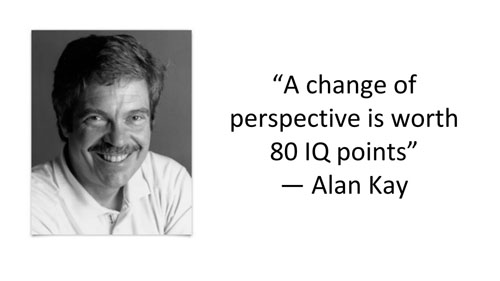
The hero doesn't just see the world he returns to differently, but is able to see differently. That distinction resonated, for example indicating the difference between the diagnostician who has great knowledge from the master diagnostician who uses perception in arriving at an accurate diagnosis. That is, one has attained mastery when one has moved beyond knowledge to developed perception. Not just a different perception, but an enhanced capacity for perception. The hero's journey is about moving to a different vantage point on one's old life, seeing it from a new perspective, with some detachment and the perspective of other experience, encounters it with altered perception. Dana pointed to the Sufi concept of organs of perception, and he added that that is what real education tries to achieve -- to develop perception, to develop the ability to shift perspective, to see what others don't see and to see more penetratingly and discerningly.

  05/07/12

It's Connected

Clusters and City Ecosystems
Value Flows and Ecosystems

Here's a piece from my 12/01/11 Trace:

From Jobs and the iPod to Gates and vaccines and Zuckerberg and social, we see the truth in:

"Here’s the truest definition of power: When you have the ability to not just solve a problem but also to create a sustainable market that addresses it." -- Matthew Herper, With Vaccines, Bill Gates Changes The World Again, 11/2/11

And not just "a market" but a webbed ecosystem, with threaded value streams that build in mutual vestment in the ecosystem.

The Power of Visual Perspective
Tools We Use, and Those That Use Us
Achieving Flow: Matters of Scale and Growing Up (or Out)

"According to Coase’s theory of The Nature of the Firm, enterprises form to avoid the transaction costs of buying services or other inputs from other organizations. But that was in 1937. Modern communications, in particular the Web, have reduced the friction costs of doing business with outsiders at the same time as increasing competition — to the extent that it’s now often cheaper to use an outside provider than an internal resource.” -- Phil Wainewright, Enter the Socialprise, March 18, 2012

"It’s because in our hyper-connected, digitally embedded, software-driven modern world, the transactional costs of marshalling and pricing resources from an almost limitless sea of autonomous providers have fallen lower than Coase could ever have imagined possible." -- Phil Wainewright, Crowd scale, friction and the nature of the firm, April 24, 2012

"When you create organizational subunits of any form, they'll have a tendency to focus internally on their own things," says Toby E. Stuart, the Charles Edward Wilson Professor of Business Administration at Harvard Business School. "Interdepartmental coordination doesn't tend to happen organically. It needs some intervention to create collaborative networks." ..."corporate staff had broader networks that reached farther and were more centralized than those in line positions. Not only did staff have more contacts, but they also were more likely to be brokers between individuals in discrete operations within the company as a whole." -- Toby E. Stuart quoted by Michael Blanding in The Inner Workings of Corporate Headquarters, April 16, 2012

As things centralized/decentralized go, this caught my eye:

Enterprise Architecture on Bredemeyer site

Here's the tweet -- it points to a bit I wrote on Enterprise Architecture and capabilities back in 2003! I had so totally forgotten about it! Don't you like that "small teams operating with sufficient autonomy not to be stifled by the corporate blanket"?

5/16/12: I've mentioned Stuart Boardman's posts on ecosystems over the past few months, but it is probably worth collecting them together for ease of reference and to give you a handle on someone else working in this "ecosystems and EA" space:


  05/08/12

From our Family's Hero

Read bottom, then top, then middle (it's Twit-formatted):

it's Twit-formatted

But there's always time for Twitter. ;-)

I followed Notch and a Minecrafter immediately followed me. I've been hanging out in the wrong crowd! ;-) I guess being a cartoon-head with architecture on the mind doesn't convey sufficiently in the architect set... Sigh.

Ok. So I like to find interesting people to follow. Sometimes I already know they're interesting, as in the case of Notch because I like to keep tabs on paradigm shifters in the software space. (Minecraft is a wonderful example of how ecosystems spring up whereever there is a rich relationship firmament to grow on. And decisions made by Notch and his team keep surprising me. The whole redstone thing, turning a game into an electronics lab, is genius. As is the whole kittens thing. Etc.)

And, according to Simon Gough's follower diagnostic, I'm BORING. Oh wait, that must mean he's WRONG! ;-) Or not. But this is my rationalization: I'm more curious than other people. CURIOSER. Not Boring. Ok? Alternatively, one could say: that I am labelled as boring in our field is an indicator of gross discrimination against cartoonheads (it couldn't be women, could it?). Wink. Just kidding. I take it as a point of pride to stay well ahead on curiosity. Q<=s are very competitive, just perversely so. ;-) If we turn hierarchy upside down, women will be on top.

my sociometer

5/14/12: Anyway it's not how many followers, but who they are, right?


Characterizing Change

We have reconceived "social" in the age of digital connectivity, and it is driving a "big shift":

"The impact of this intensified competition and volatility on firms is further captured in two additional findings. First, the gap in ROA performance between those companies doing well, and those lagging behind has increased over time, with the winners barely maintaining their previous performance levels, while the losers experience rapid deterioration in performance. And, the topple rate–which tracks the rate at which companies change rank–has more than doubled, suggesting that winning companies have a tough time keeping their leadership position for long. Business feels more and more like a contact sport." -- Irving Wladaws, Why People Are Gaining Power Over Organizations in the Age of IT, April 23, 2012

And the shift is hitting the software development fan:

(Sorry, couldn't resist the word play. Of course, Shift Happens is old already, but it gets a whole new spin when it hits the fan...)


Mechanisms

One of the distinguishing responsibilities of the architect is identifying and designing mechanisms for system integrity and resilience (and other sustainability factors).

"Managed Data is a two-level approach to data abstraction in which programmers first define data description and manipulation mechanisms, and then use these mechanisms to define specific kinds of data. Managed Data allows programmers to take control of many important aspects of data, including persistence, access/change control, reactivity, logging, bidirectional relationships, resource management, invariants and validation." -- Alex Loh, Tijs van der Storm and William R. Cook, Managed Data: Modular Strategies for Data Abstraction

Good news:


Must See

Amory Lovins: A 50-year plan for energy, TED, March 2012:

There is so much in that talk of note! But. It's late. If you take notes while you watch it, send them to me and I'll add them here. ;-) (I was working out; oh hm, I need to triple task and take notes while I watch and work out...)


Must Read

Dana Bredemeyer pointed me to this section in James Madison's notes from the Constitution Convention (the Yale site is an awesome resource):

'I confess that there are several parts of this constitution which I do not at present approve, but I am not sure I shall never approve them: For having lived long, I have experienced many instances of being obliged by better information, or fuller consideration, to change opinions even on important subjects, which I once thought right, but found to be otherwise. It is therefore that the older I grow, the more apt I am to doubt my own judgment, and to pay more respect to the judgment of others. Most men indeed as well as most sects in Religion, think themselves in possession of all truth, and that wherever others differ from them it is so far error. Steele a Protestant in a Dedication tells the Pope, that the only difference between our Churches in their opinions of the certainty of their doctrines is, the Church of Rome is infallible and the Church of England is never in the wrong. But though many private persons think almost as highly of their own infallibility as of that of their sect, few express it so naturally as a certain french lady, who in a dispute with her sister, said "I don't know how it happens, Sister but I meet with no body but myself, that's always in the right-Il n'y a que moi qui a toujours raison."

In these sentiments, Sir, I agree to this Constitution with all its faults, if they are such; because I think a general Government necessary for us, and there is no form of Government but what may be a blessing to the people if well administered, and believe farther that this is likely to be well administered for a course of years, and can only end in Despotism, as other forms have done before it, when the people shall become so corrupted as to need despotic Government, being incapable of any other. I doubt too whether any other Convention we can obtain, may be able to make a better Constitution. For when you assemble a number of men to have the advantage of their joint wisdom, you inevitably assemble with those men, all their prejudices, their passions, their errors of opinion, their local interests, and their selfish views. From such an assembly can a perfect production be expected? It therefore astonishes me, Sir, to find this system approaching so near to perfection as it does; and I think it will astonish our enemies, who are waiting with confidence to hear that our councils are confounded like those of the Builders of Babel; and that our States are on the point of separation, only to meet hereafter for the purpose of cutting one another's throats. Thus I consent, Sir, to this Constitution because I expect no better, and because I am not sure, that it is not the best. The opinions I have had of its errors, I sacrifice to the public good. I have never whispered a syllable of them abroad. Within these walls they were born, and here they shall die. If every one of us in returning to our Constituents were to report the objections he has had to it, and endeavor to gain partizans in support of them, we might prevent its being generally received, and thereby lose all the salutary effects & great advantages resulting naturally in our favor among foreign Nations as well as among ourselves, from our real or apparent unanimity. Much of the strength & efficiency of any Government in procuring and securing happiness to the people, depends, on opinion, on the general opinion of the goodness of the Government, as well as well as of the wisdom and integrity of its Governors. I hope therefore that for our own sakes as a part of the people, and for the sake of posterity, we shall act heartily and unanimously in recommending this Constitution (if approved by Congress & confirmed by the Conventions) wherever our influence may extend, and turn our future thoughts & endeavors to the means of having it well administred.

On the whole, Sir, I can not help expressing a wish that every member of the Convention who may still have objections to it, would with me, on this occasion doubt a little of his own infallibility, and to make manifest our unanimity, put his name to this instrument.'

-- Benjamin Franklin, as quoted in James Madison's notes on the Debates in the Federal Convention, September 17, 1787

Why do I say that's a must read? Think architecture. ;-)

Oh, yeah, have you read "What it Takes to be a Great Enterprise Architect"? Have you recommended it to others? Well, why ever not?

And, to make sure your information diet has a suitable mix tonight, Martin Fowler's OrmHate piece is worthwhile.

5/9/12:

"Anger is never without a reason but seldom a good one." - Benjamin Franklin (via Philip Hartman‏ @gvillearchitect)


  05/09/12

Design Perspectives

"The Gehry design approach works from both the inside out, as in the massing- models, and from the outside in based on freehand sketches of the building by Frank Gehry, such as shown in Figure 1.1. These are meant to be spontaneous and evocative of both form and emotion. A constant problem he recognizes is how to keep the feelings of the initial sketches as the architects proceed through the design. An important strategy in that process of trying to keep the feelings alive is to work with their hands, making models of the exterior and interior elements out of paper, metal, plastic, waxed cloth, or whatever material gives them both the form and feeling that they are seeking. There is an important lesson here for management. As Edwin Hutchins demonstrates in Cognition in the Wild, thinking is not something done exclusively inside the head, but is often accomplished in interaction with other people and with our tools. Spreadsheets are one example of how managers use tools for thinking, and tactile, material models are another, relatively unexplored possibility. The more ways of thinking we have available to us, the better our problem-solving outcomes can be."

-- Richard j. Boland jr. and Fred Collopy, Introduction to Managing as Designing, 2004

Given the introduction to Managing as Designing, I'm excited to put it on my "up next to read list"! It addresses managers, but could just as well be addressed to enterprise architects and senior software architects and... well, if it is as good as it promises, I'd recommend it to any architect in IT and product development but not all would thank me. ;-) Then again, not all would a priori know to thank me for a pointer to Argyris or March. Still, those who (come to) grok that the non-technical aspects of the role of the architect really rachet up when organizational scaling issues mount (so one needs to do more with and through others, more effectively) will (come to) recognize the value.

SATURN2012 from the Sidelines

Michael Stal

This one served as a percolator (surfacing a tacit understanding) for me:

Widen the scope! Its not architecture OR value!!!

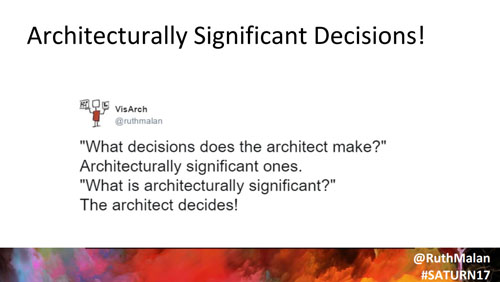
Architecture is the vehicle for value, not a trade-off against value. Of course I get that the issue being dealt with here has to do with the tension between unarchitecture (quick and dirty get it working) versus refactoring and just enough design for structural integrity and sustainability, including sustainable team flow. There is no quick-fix for judgment. It has to be developed. Experience factors (and refactors).

Wow, two years have passed since I presented The Art of Drawing People In tutorial at SATURN! I've much enjoyed encounters with various people on the SEI team and they draw a great community together. And it's fun being on both sides of the conference firehose. Last time I was only able to be there for the evening before my tutorial but at least I had the chance to have dinner with Olaf Zimmermann and George Fairbanks and a couple of architects whose names (hit me) I don't remember. Well, maybe next year I'll summon the audacity to submit the Something About Boxes tutorial again. Wink. Though perhaps I may frame it in more conventional (in-the-box) terms. Grin. Perhaps I should reign in my playfulness... (Really, if you don't get me, you could watch Funny Girl. Then it will all fall into place. Or, if the pace of the movie frustrates the thoroughly modern you, I'll cut to the chase and say Streisand's character uses making fun of her own weak points to take that arrow out of the quiver of her detractors. Of course you have to understand that she could not do this if she wasn't absolutely confident about her strong points; she is spunky because she has a strong foundation.)


Moving the Flag

I was surprised to see the following apparently attributed to Len Bass:

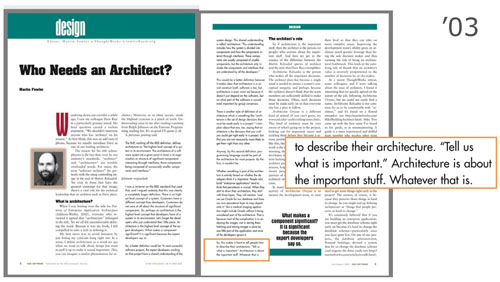
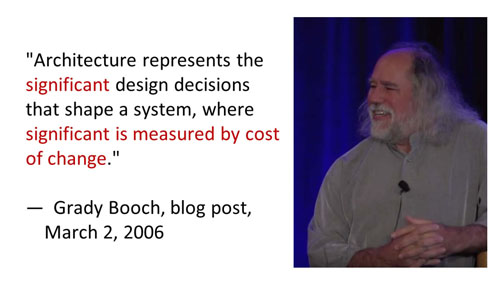
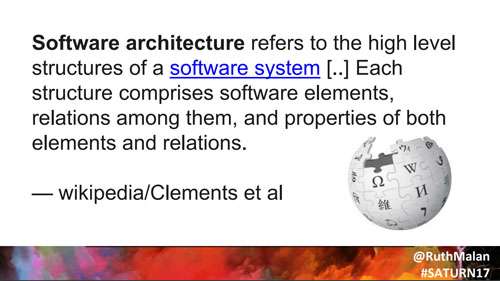
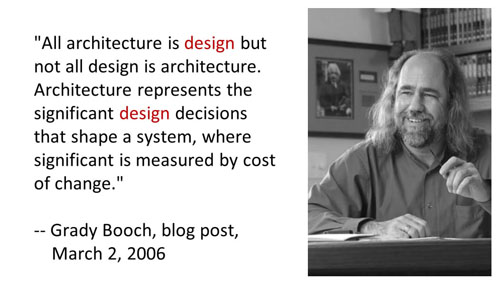
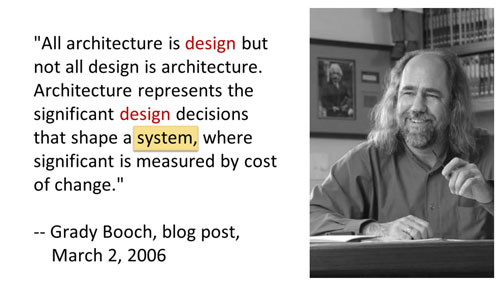
"Len Bass: Design is a continuous activity of making decisions. Begin with decisions that have broad systemwide scope, move to collection of decisions that have narrow scope. Decision is architectural if it has systemwide impact or affects achievement of a quality attribute important to system. Strategic design and tactical design. At beginning consider only strategic requirements. Tactical perspective encompasses local design decisions with non-systemic impact." notes taken on Michael Stal's keynote at SATURN, May 9, 2012

This is from the Software Architecture: Central Concerns, Key Decisions chapter (in the Software Architecture Action Guide draft) we wrote in 2002:

A distinctive characteristic of architectural decisions is that they need to be made from a broad-scoped or system perspective. Any decision that could be made from a more narrowly-scoped, local perspective, is not architectural (at the current level of system scope). This allows us to distinguish between detailed design and implementation decisions on the one hand, and architectural decisions on the other—the former have local impact, and the latter have systemic impact. That is, architectural decisions impact, if not all of the system, at least different parts of the system, and a broad-scoped perspective is required to take this impact into account, and to make the necessary trade-offs across the system.

...

However, a decision may have systemic impact but not be very important, in which case it is also not architectural. By nature, architectural decisions should focus on high impact, high priority areas that are in strong alignment with the business strategy, as shown in Figure 1. ...

Based on our discussion of key concerns addressed by software architecture, we see that, at a minimum, architectural decisions have to do with
• system priority setting
• system decomposition and composition
• system properties, especially cross-cutting concerns
• system fit to context
• system integrity
Let us consider each of these in turn, though they are certainly not mutually exclusive sets of decisions!

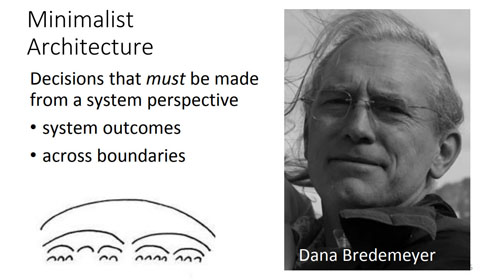
But then I reread our Less is More with Minimalist Architecture paper published by the IEEE in 2002, and perhaps I left room for someone to mistakenly attribute more of what I wrote there to Len than "'these decisions identify the system’s key structural elements, the externally visible properties of these elements,and their relationships' (Len Bass, Paul Clements, and Rick Kazman, Software Architecture in Practice, Addison-Wesley, 1997)". But it does remind me, if you hadn't read it, you might be interested to -- as you can see, given that our guidance in that 2002 paper was an important part of a keynote in 2012, we did pretty well. ;-)

Rereading Less is More, I'm relieved to see that it mostly stands up well to the test of time, though I'd change some of the phrasing if I could. ;-) For example, there are antibodies to the word "asset" now that I'd avoid setting off -- though as you well know, I, and others who talk about people as assets, do not mean for it to be interpreted in mechanistic-economic terms! [If I say my writing skill is my best asset, I don't mean it is my slave... I can't even manage it ;-)] Sometimes people can get upset at a word, because they are opposed to something else in the context -- for example, where there is an orientation to treating people like things that can be hired and fired without thought to the personal consequences then the asset word carries that negative spin. And so forth. Naturally that is very far from my orientation. So I hope people read the paper with goodwill enough not to be rattled by a word here and there. :-)

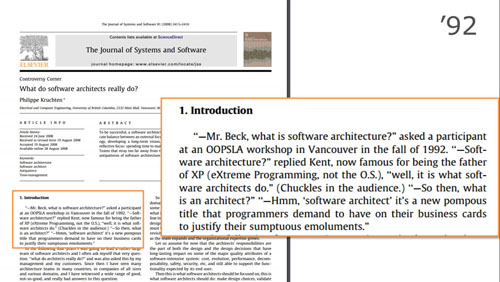
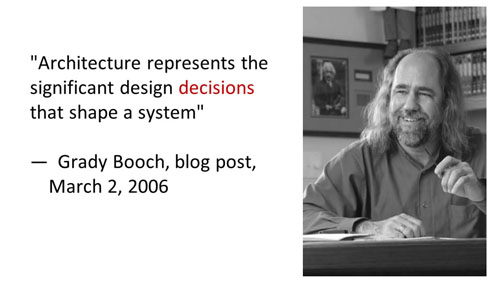
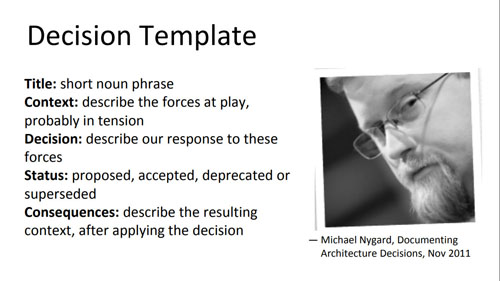
Of course I have learned a lot in the interim decade, and all I have learned is to be credited to the architects I have interacted and worked with -- those who have mightily disagreed with me actually perhaps less than one might think, for it is in respectful peer discussions that I am at my most productive and resourceful and most able to do an about-face and see things from a new vantage point. With reference to the specific paper, I would put more emphasis on the left hand-right hand image and the importance of working through cultural mechanisms not just through decisions -- the message is there, but I would highlight it more. We have emphasized decisions a lot in the architecture field, but they're not the full story. ;-) Again, there we are somewhat to blame, for our Software Architecture Decision Model is a peer (circa mid-90's) model to Philippe Kruchten's more well-known 4+1 View Model. Philippe had the good sense to publish formally, while I was early to the Internet band of free and open access -- I created and was principal writer for the Fusion site (and published the Fusion Newsletters online) and then the HP Software Architecture site and later the Bredemeyer site through the 90's. Well, all that is merely of passing note. Let me return for the moment to my criticism of my 10-year ago self and what I wrote in that short paper: I would also do a better job of framing the context (considerations about scope -- architecture for complex system or for family of products, etc.) for what I had to say.

The neat thing reading that work again is that it has held up rather well. I believe we have learned a lot, and I would cast some things rather differently, but it is good to be reminded -- especially comparing what we were saying, teaching and writing then to what others are saying now -- that we were leading. Alternately put, we need to get the book that reflects the current state of our understanding written. So that I can look at it in ten more years and wince in parts and be relieved in others to still be relevant and useful. Hopefully. ;-)

One of the things we've been doing differently since that chapter was drafted in 2002, is more explicitly address uncertainties, challenges and risks. Sure, this shows up in that earlier work (for example in priority setting), but under the influence of Charlie Alfred we made it a much more explicit part of the process. Some of what we learn is about emphasis, and framing (how we articulate the importance). [Using Architecture Challenges To Formulate Software Architecture Published: Mar 19, 2003] Anyway, hats off to Charlie. Take a bow Mr. Alfred. :-)

Oh, as things "meta" go, Dana pointed me to this: This Story Is So 'Meta', npr, May 5, 2012.

That was random. ;-)

5/15/12:

Indeed!

I've had managers who stayed out of our way technically, but got access to resources that enabled us to do what we were seeking to do. I certainly wouldn't have wanted those managers to feel invisible and unappreciated, nor to be invisible and ineffective with regards to enabling us. They were very effective advocates and interpersonal skills coaches and they created the context for us to be successful. That included holding us accountable for figuring out dead-ends and redirecting, and stepping in if we were ineffective or holding on to initiatives that were flagging and floundering.

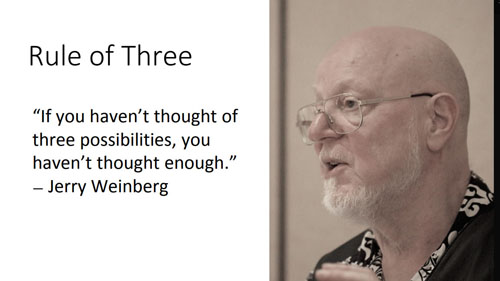
Jerry Weinberg makes a different point, which I think relates more to hubris and self-interest, and can (does?) get in the way of being good team player.


  05/11/12

Salt Mines

I've been working on advancing what we do in the ecosystems space, to create models of what is changing in the business world as it is reinventing itself with a fundamentally digital -- rather then human-organic -- nervous system... one where human brains plug in like nodes in the organizational brain... Yes, I pitched that in provocative terms. Still, I do think that there is an important insight there: the big disruption is the disruption of people -- we are ever advancing the realms of work we automate and displacing jobs to digitally-intelligenced machines at a rate that is overwhelming society and sending shock waves through our economic and socio-political systems. I think we need a handle on that, and what it means for society. That sort of thing.

But I'm trying to characterize what is going on here, in the organization and the ecosystem, so I can help our field advance -- figure out how to adapt what we do in our modeling work, what is a minimalist view of what we characterize for strategy and architecture so the integration is sensible... (that is, sense-able and sensible)... So, yes, this is a very intense research phase and if I give you a glimpse of what is going on in the head-space I can share, this is what you see.

That said, I see what I am doing more as "architecting the space" -- the models we use to understand a space shape it, they shape what we see, hence what we act on... so understanding the structure and dynamics that underlie business ecosystems, strategy and enterprise architecture is wickedly important, wickedly hard, and wickedly engulfing! Right? Just like the size of rocket boosters on the space shuttle was dictated by what trains could carry, dictated in turn by horse-drawn wagons going back to Roman chariots, the mental frames through which we view the world determine in important ways what we are able to see -- and what is occluded. Our thinking frames become ruts. Simple frames are immensely useful. And they limit. Not that I allow myself to be too self-important here, for there are many perspectives. Nonetheless, it is work I feel requires a responsible orientation.

I want to be beyond this research phase, I really do! I'm desperately hungry to switch gears from direction finding in the ecosystem/strategy/EA space to tunneling down in writing code -- I like the interactive feedback loop with computers. But I need to feel that what minimal pieces I put together to inform strategy and EA from the ecosystems vantage point are useful in helping to create architectures that are "good, right and successful."

We take big complex soup and boil it down to a simple just enough "scaffolding" that helps those who work with us create great systems. You see me grappling with the soup -- the interwoven mess of a business world in tremendous flux. Perhaps I should hide that process. I certainly don't want the grappling to diminish how you view the results I draw out. The simple models and relationships, the crystals of vision.

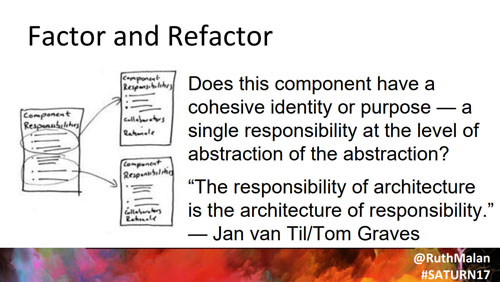
So I like to think that what I do is "advance frontiers" ;-) But "fomenting a philosophy of technology" captures a dimension of what this Trace is about. Mainly it is about the architecture of architecture. Characterizing its identity, its differentiating value, the capabilities that allow that value to be created, enhanced and evolved, the design of design. And architectures evolve. So yes, I explore that evolution here.


Dana BredemeyerFollow Forward

Thank You to Kris Meukens for the #follow friday. :-) I value the goodwill and expression thereof, and I'm grateful for the thoughtful gesture of community building. A gesture of reciprocal goodwill would include, for example, following Kris. And while you're including more good men in the circle you follow, you might like to add Dana Bredemeyer.

Or not. We wouldn't want anyone to think I have any influence, now would we? Or discernment. Well, clearly not that.

As following goes... my Business Ecosystems and Characterizing Change Pinterest boards are coming along nicely, don't you think? (Btw, Pinterest won't grab an image from some sites -- such as Stuart Boardman's Scrbd insert on his Metropolis post. Just so you know I wasn't ignoring Stuart. ;-)

Image source: Bits & Chips, Stoomcursus systeemarchitectuur

  05/12/12

Experience Maps

  05/14/12

Leaky Networks and Serendipity

The paragraphs below, from Frank Duffy's wonderful article "Lumbering to Extinction in the Digital Field", struck me:

from "Lumbering to Extinction..." by Frank Duffy

The paper is a thought provoking treatment of one of the ways digital connectedness is reshaping society -- influencing the very physical structures that house it, but also the ways that we relate to the physical and social spaces of organizations and cities, and the ways they cause us to relate among ourselves.

Quite handsome in formal grey suit, don't you think?

  05/16/12

Conduits for Caring

Nick Carr really challenges me to think because he sees things, well, politely, differently. So he puts "technologies of self" at the top of his innovation pyramid. And one way to see the likes of Facebook is as a podium for projecting self, and because we strive for authenticity, building "self" -- the image of self that pulls us into who we are ..becoming. So it is a platform for low-barrier-to-entry self-broadcast and a mirror in which we see ourselves -- in part as we would like others to see us, and so strive to become. Etc. At least that's my 2 minute hit on what "technologies of self" are about.

Yet Facebook and other social platforms aren't just about broadcast, they're about connecting. Which is somewhat about broadcasting, but also about transferring, moving information through circles of influence. And about moving caring. Humans connect, share stories, and develop empathy and caring. This is not about self. This is about community, about relationships and connections -- local and distributed, friendships and collegial relationships that form around shared interests, concerns, passions, quests for meaning in larger contexts than "self."

So is the pyramid upside-down? Does innovation serve the increasing scope of organism, going beyond individual to more interwoven networks of social interaction, ever pushing out the boundaries of the new social organisms so formed? We see this progression in mechanistic systems, and social systems, and socio-technical systems -- from simple to complex systems of increasingly diverse yet inter-dependent systems.

Whether than makes any sense of not, Carr's reference to Maslow's Hierarchy reminded me of this post: Leadership and The Brain.

Anyway, it seems to me that as innovation continues to reshape experience and advance what is possible, we cannot afford to lose caring. And caring is interpersonal and needs to be communicated. Otherwise it becomes a mechanistic network of information flows that simply serve the emergent technological organism ever driving innovation in the direction of more and more capable, sensing-responding, intelligence-supplied and intelligence-forming, machines.

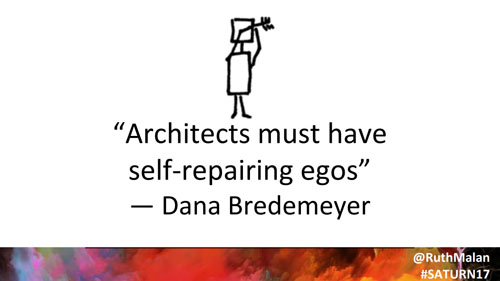
We each have an ego bubble that is deflated easily by negative or simply flat responses to the work we pour passion into. Enthusiasm -- evident, communicated enthusiasm -- for what we do is important to maintaining a healthy ego bubble that buoys our spirits. Of course, we need a just enough ego bubble or our self-sense gets over-inflated and the loft is too much.

(The ego bubble concept comes courtesy of our 12 year old resident sage.)

5/17/12:

  • Point: The Tech Evolution, Kevin Kelly interviewed about his book What Technology Wants by David Merkoski
  • Counterpoint: “Companies die because their managers focus on the economic activity of producing goods and services, and they forget that their organizations’ true nature is that of a community of humans.” -- Arie de Geus, The Living Company: Habits for Survival in a Turbulent Business Environment quoted in The Connected Company, Dave Gray


  05/17/12

Toyota's A3 Reports

"An A3 is composed of a sequence of boxes (seven in the example) arrayed in a template. Inside the boxes the A3’s “author” attempts, in the following order, to:

  • establish the business context and importance of a specific problem or issue;
  • describe the current conditions of the problem;
  • identify the desired outcome;
  • analyze the situation to establish causality;
  • propose countermeasures;
  • prescribe an action plan for getting it done; and
  • map out the follow-up process."

-- Toyota’s Secret: The A3 Report, John Shook, July 1, 2009

Want me to show you how I relate this to Architecture Principles?


Carrots

I was bouyed by very kind words on one of the Bredemeyer mailing list sign-ups that came in today. Since that is the other site I write, I like those encouragement "carrots" -- a lot. And I know, I know. I should use every jot of writing energy to write more useful stuff... This Trace is not consumable, nor commendable. But here I write as me. And I believe it is not just useful as a source of pointers to other work, but for the hard-wrought but vividly cast insights herein.

Yes, yes, I know that if I want my work to be advocated I need to do work worth advocating. And this Trace is not it.


I also write at:

- Bredemeyer Resources for  Architects

- Trace In the Sand Blog

- Follow ruthmalan on Twitter


Journal Archives


Journal Map

2012

- January

- February

- March

- April

- Current

2011

- January

- February

- March

- April

- May

- June

- July

- August

- September

- October

- November

- December


More Archives


May Posts

Architects

-


Architecting

-


Strategy, Innovation, Ecosystems

- Ecosystems and Relationship Platforms


Enterprise Architecture

- EA as Strategic Advantage


Software Architecture

-


Scanning Trends and Other

-

-


Blogroll

Chief Scientists

- Grady Booch

- Michael Feathers

- Martin Fowler

Enterprise Architects

- John Ayre

-Peter Bakker

- Stuart Boardman

- Todd Biske

- Adrian Campbell

- Louis Dietvorst

- Leo de Sousa

- Johan Den Haan

- Chris Eaton

- Roger Evernden

- Ondrej Galik

- John Gotze

- Tom Graves

- Melvin Greer

- Adrian Grigoriu

- Carl Haggerty

- Dion Hinchcliffe

- Paul Homan

- Brian Hopkins

- James Hooper

- Martin Howitt

- Kristian Hjort-Madsen

- Alan Inglis

- Janne J. Korhonen

- Nick Malik

- Alex Matthews

- Brenda Michelson

-

- Sethuraj Nair

- Doug Newdick

- Steve Nimmons

- Jim Parnitzke

- Chris Potts

- Randall Satchell

- Praba Siva

- Serge Thorn

- Bas van Gils

- Jaco Vermeulen

- Richard Veryard

- Mike Walker

- Tim Westbrock

Architects and Architecture

- Charlie Alfred

- "Doc" Andersen

- Tad Anderson

- Jason Baragry

- Simon Brown

- Peter Cripps

- Rob Daigneau

- Udi Dahan

- Tony DaSilva

- Matt Deacon

- Peter Eeles

- George Fairbanks

- Kevin Francis

- Sam Gentile

- Simon Guest

- Philip Hartman

- Todd Hoff (highly recommended)

- Gregor Hohpe

- Steve Jones

- Frank Kelly

- Kirk Knoernschild

- Philippe Kruchten

- Sjaak Laan

- Dave Linthicum

- Anna Liu

- Nick Malik

- Chirag Mehta

- JD Meier

- Kris Meukens

- Gabriel Morgan

- Robert Morschel

- Dan Pritchett

- Chris Potts

- Bob Rhubart

- Arnon Rotem-Gal-Oz

- Carlos Serrano-Morales

- Shaji Sethu

- Leo Shuster

- Collin Smith

- Brian Sondergaard

- Michael Stahl

- Daniel Stroe

- Gavin Terrill

- Jack van Hoof

- Steve Vinoski

- Mike Walker

- Rebecca Wirfs-Brock

- Rodney Willis

- Eion Woods

- Brian Zimmer

Architect Professional Organizations

- CAEAP

- IASA

- SATURN

Software Visualization

- Adrian Kuhn

- Jennifer Marsman

Domain-Driven Design

- Dan Hayward

Agile and Lean

- Scott Ambler

- Alistair Cockburn

- NOOP.nl

- hackerchickblog

- Johanna Rothman


Agile and Testing

- Elisabeth Hendrickson

- Elizabeth Keogh

Software Reuse

- Vijay Narayanan

Other Software Thought Leaders

- Jeff Atwood

- Scott Berkun

- CapGeminini's CTOblog

- John Daniels

- Brian Foote

- Joel Spolosky

CTOs and CIOs

- Rebecca Parsons

- Werner Vogels (Amazon)

CEOs (Tech)

- Jonathan Schwartz (Sun)

CEOs (Web 2.0)

- Don MacAskill (SmugMug)

Innovate/Tech Watch

- Barry Briggs

- Tim Brown (IDEO)

- BoingBoing

- Mary-Jo Foley's All About Microsoft

- Gizmodo

- Dion Hinchcliffe

- Oren Hurvitz

- Diego Rodriguez

- slashdot

- smoothspan

- The Tech Chronicles

- Wired's monkey_bites


Creativity

- Marci Segal


Visual Thinking

- Amanda Lyons


Social Networking/Web 2.0+ Watch

- bokardo.com

- Mashable


Visual Thinking

- Dave Gray

- Dan Roam

- David Sibbet (The Grove)

- Scott McLoud


Leadership Skills

- Presentation Zen


Strategy, BI and Competitive Intelligence

- Freakonomics blog

- Tom Hawes

- Malcom Ryder


Um... and these
- Nick Carr

- Tom Peters


Green Thinking

- Sylvia Earle, TED

- CNN Money Business of Green videos

- Matter Network
 

Comics

- xkcd

- Buttercup Festival

- Dinosaur comics

- geek&poke

- phd comics

- a softer world

- Dilbert


I also write at:

- Resources for Software, System and Enterprise Architects

- Trace In the Sand Blog

- Follow ruthmalan on Twitter


Papers:

- Strategy, Architecture and Agility: The Art of Change: Fractal and Emergent, 2010 

- Innovation and Agile Architecting: Getting Past ‘But’: Finding Opportunity and Making It Happen, 2008


Feedback: I welcome input, discussion and feedback on any of the topics in this Trace in The Sand Journal, my blog, and the Resources for Architects website, or, for that matter, anything relevant to architects, architecting and architecture! I can be reached at

Restrictions on Use: If you wish to quote or paraphrase original work on this page, please properly acknowledge the source, with appropriate reference to this web page. If you wish to republish any of Ruth Malan's or Bredemeyer Consulting's work, in any medium, you must get written permission from the lead author. Also, any commercial use must be authorized in writing by Ruth Malan or Bredemeyer Consulting. Thank you.

Visualization

- Links to tools and other resources


Misc.

- Other Interests

- Introducing Archman

- Picture It presentation


Email:

-
 

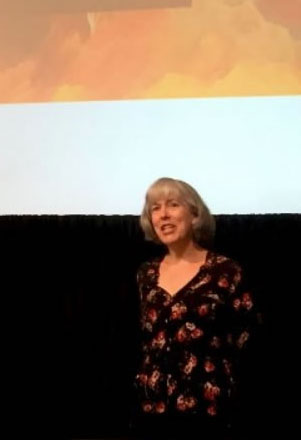
a deer in the headlights sort of look is just perfect next to an expression of openness to feedback ;-)

Copyright © 2012 by Ruth Malan
http://www.ruthmalan.com
Page Created:May 1, 2012
Last Modified: May 17, 2012